What "Throw" Really Means
In technical terms, "throw" usually describes SPL at distance. Barring reflections and interference, sound loses energy at a rate of 6dB per doubling of distance — and that affects all subwoofers equally.
Why Individual Subwoofers Can't Be "Long-Throw"
Individual, portable subwoofers can't be long-throw by virtue of the fact that they are not large enough to produce meaningful directivity throughout the subwoofer frequency range.
Significant directivity is achieved when a dimension of the radiating area is greater than or equal to the wavelength being produced. A subwoofer operating from 80Hz down to 25Hz is radiating frequencies with wavelengths from 14 feet up to 45 feet. Even at 80Hz, there would not be sufficient directivity to be called "long throw."
What Makes a Sub Seem "Long-Throw"
If a box is tuned to be particularly loud at a particular frequency, it will be perceived to be louder at any distance at that frequency. Every sub I've ever heard described as "long-throw" was particularly more sensitive at higher frequencies than lower ones.
Boxes that are effective at upper-bass frequencies can benefit from limited directivity at those frequencies, making them seem very loud and "long-throw" — but at the price of flat frequency response and low frequency extension.
The Two Conclusions
- Portable products described as long-throw subwoofers are not operating in the subwoofer frequency range — so they are not subwoofers.
- Portable products described as long-throw subwoofers that do operate in the subwoofer frequency range cannot be long-throw because of the rules of physics.
There's no such thing as a long-throw subwoofer.
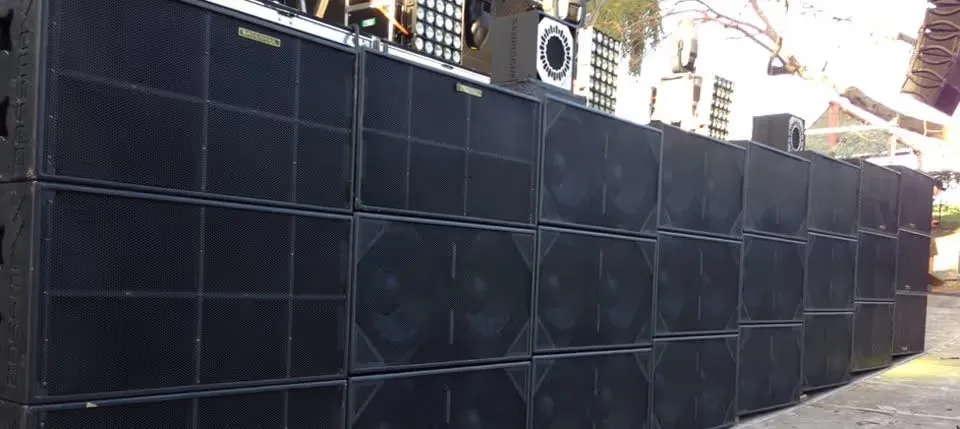
The only way to achieve directivity at subwoofer-appropriate frequencies is with an array of boxes.